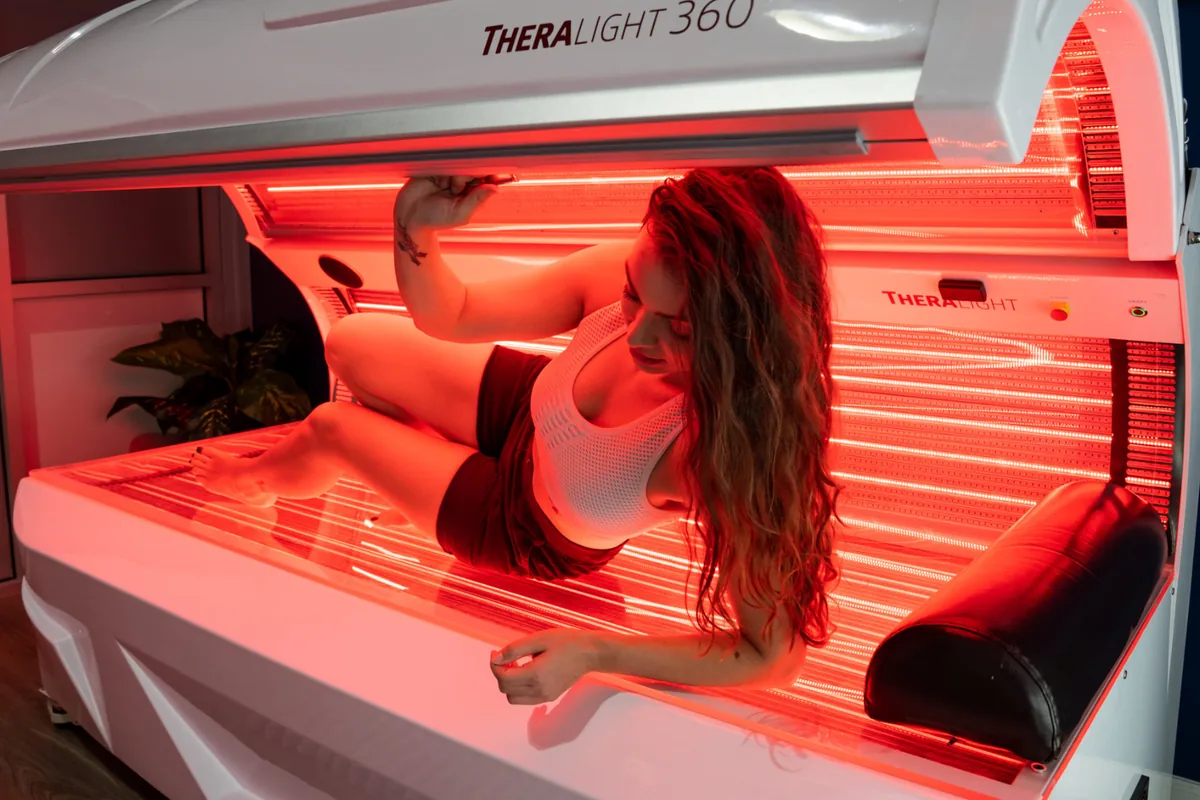
What if one of the most relaxing parts of your week also supported your skin, muscles and recovery?
That's the appeal of red light therapy at iCRYO Mauldin. It's gentle, painless and takes just minutes.
Here's what red light therapy is, how it works and who it's for.
Quick answer: Red light therapy uses specific wavelengths of red and near-infrared light to support how your cells produce energy. People use it to support skin health and collagen, muscle recovery and overall wellness. It's painless, uses no UV light and sessions typically take 10–20 minutes.
What Is Red Light Therapy?
Red light therapy, also called photobiomodulation, exposes your skin to low-level red and near-infrared light.
Unlike UV light from the sun or tanning beds, these wavelengths don't damage skin. Instead, they're absorbed by your cells and used to support normal function.
How Red Light Therapy Works
Here's the simple version.
Light gets absorbed by your cells
Red and near-infrared light penetrate the skin. Inside your cells, they're absorbed by the mitochondria, the structures that produce cellular energy.
Cells get an energy boost
Research suggests this light helps mitochondria work more efficiently, supporting the energy your cells need to repair and renew.
Different wavelengths, different depths
- Red light acts mostly on the skin
- Near-infrared light penetrates deeper into tissue and muscle
What People Use Red Light Therapy For
- Skin health: tone, texture, fine lines and collagen support
- Muscle recovery: after workouts and long days outdoors
- Joint comfort: many people use it for stiff, achy areas
- General wellness: a relaxing, restorative routine
See the full list in Does Red Light Therapy Help Skin and Recovery?.
What a Session Is Like
- Arrive and prep. Clean skin works best.
- Protect your eyes with provided eyewear if recommended.
- Relax in front of or inside the red light device.
- Enjoy gentle warmth for the length of your session.
- Go about your day. No downtime.
Who Should Talk to Us First?
Red light therapy is gentle, but let us know if you are pregnant, are sensitive to light, take medications that increase light sensitivity or have a history of skin cancer.
In-Clinic vs. At-Home
At-home panels are everywhere. How do they compare to professional devices? Read Red Light Irradiance: At-Home LED Panels vs Clinical Beds.
How Often Should You Go?
Red light therapy works best with consistency. See Does Red Light Therapy Help Skin and Recovery?
Red Light Therapy Myths vs. Facts
Myth: "It's the same as a tanning bed." Fact: Tanning beds use UV light, which damages skin. Red light therapy uses red and near-infrared wavelengths that don't tan or burn.
Myth: "Any red light bulb will do." Fact: Results depend on specific wavelengths and enough power to reach your cells. Professional devices are designed for that. Read Red Light Irradiance: At-Home LED Panels vs Clinical Beds.
Myth: "One session will transform your skin." Fact: Red light therapy works through gradual processes like collagen production. Consistency over weeks delivers results.
Myth: "Red light therapy replaces sunscreen." Fact: It supports skin repair, but it doesn't protect against UV. Daily SPF is still essential, especially under the Carolina sun.
Ready to glow?
Red Light Therapy in Mauldin, SC
iCRYO Mauldin is at 100 N Main St STE. B, Mauldin, SC 29662, on North Main Street with free on-site parking. We welcome clients from Simpsonville, Greenville, Fountain Inn, Five Forks, Taylors and Greer.
Questions? Call (864) 478-7429.