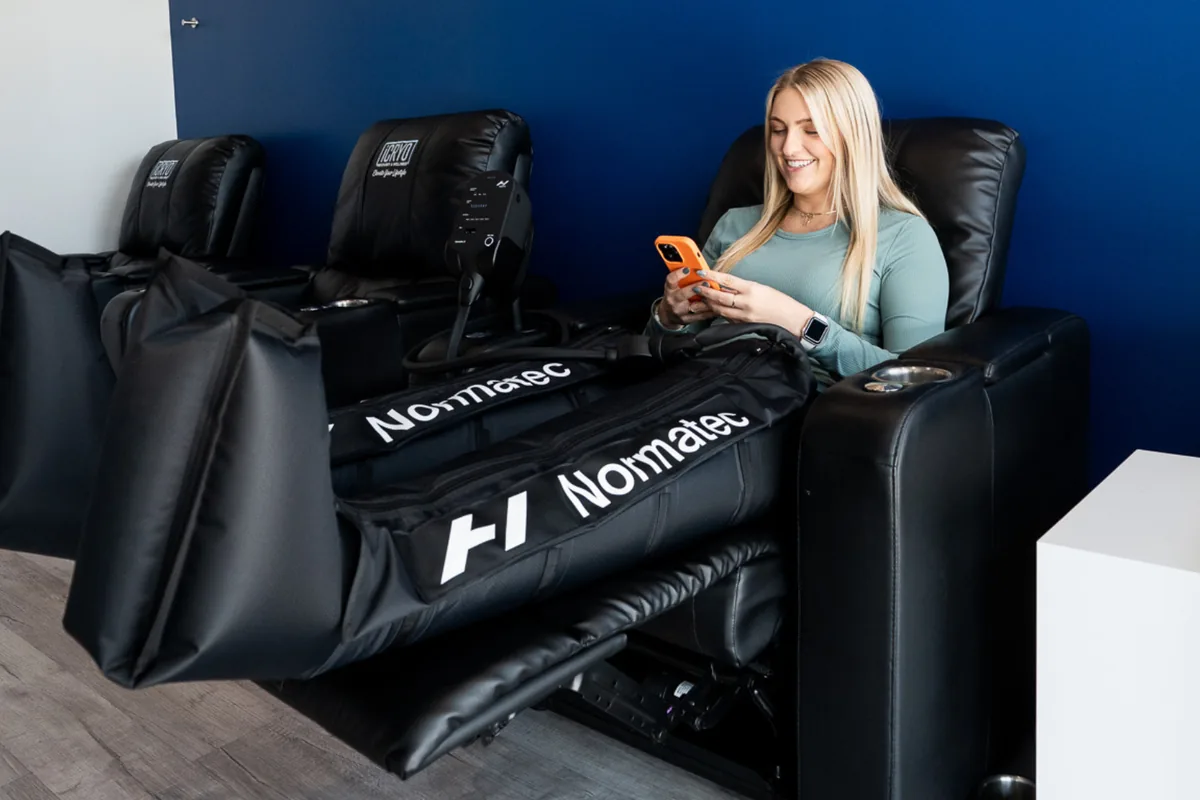
Imagine sliding into a pair of oversized boots, leaning back and letting a rhythmic, full-leg squeeze melt away the heaviness from a long day.
That's compression therapy at iCRYO Mauldin. Here's how it works and who it's for.
Quick answer: Pneumatic compression therapy uses air-filled sleeves, usually on your legs, that inflate and deflate in sequence to squeeze and release your muscles. This supports circulation and lymphatic flow, helping with recovery, soreness and swelling. Sessions often take 20–30 minutes and feel like a deep, relaxing massage.
What Is Compression Therapy?
Compression therapy uses pneumatic (air-powered) sleeves that wrap around your legs (and sometimes arms or hips). The sleeves fill with air in sections, applying gentle, rhythmic pressure.
You might know it as "compression boots," the kind you've seen pro athletes use on the sidelines.
How It Works
Your body moves fluid in two main ways:
- Blood circulation, pumped by your heart
- Lymphatic flow, which depends on muscle movement to move fluid and waste
When you're sore, tired or sitting for long periods, fluid can build up in your legs.
Compression therapy mimics the natural muscle pump. The sleeves inflate from your feet upward in a wave, helping move fluid toward your heart. Then they release, and the cycle repeats.
What a Session Is Like
- Slip on the sleeves over your clothes
- Lean back and get comfortable
- Relax as the sleeves inflate and deflate rhythmically
- Adjust pressure as needed for comfort
- Walk out feeling lighter, with no downtime
Who Uses Compression Therapy?
- Runners, cyclists and team athletes after training or competition
- People who stand or sit all day
- Travelers after long flights or drives
- Anyone with tired, heavy legs
See Maximize Athletic Recovery with Compression Therapy.
Who Should Talk to a Provider First?
Compression therapy isn't right for everyone. Talk with us or your doctor first if you have:
- A history of blood clots (DVT)
- Congestive heart failure or other heart conditions
- Open wounds, infections or skin conditions on your legs
- Peripheral vascular disease
- Pregnancy
Compression vs. Lymphatic Massage
How does it compare to a manual lymphatic drainage massage? Read Support Your Lymphatic System with Professional Compression Therapy.
Pair It With Other Recovery Services
Compression pairs well with cryotherapy, infrared sauna and red light therapy. It's also a nice complement to T-Shape 2 body treatments.
Compression Therapy Myths vs. Facts
Myth: "It's the same as wearing compression socks." Fact: Compression socks apply steady pressure. Pneumatic compression inflates and deflates in sequence, creating a wave that mimics your muscles' natural pump.
Myth: "Compression therapy is only for elite athletes." Fact: Pros made it popular, but it's great for anyone with tired legs, including nurses, teachers, travelers and weekend warriors.
Myth: "More pressure is always better." Fact: Comfortable pressure is the goal. Our team adjusts the settings so the session feels good.
Myth: "It treats swelling from any cause." Fact: Sudden, painful or one-sided swelling needs a doctor's evaluation, not a recovery session.
Ready to give your legs a break?
Compression Therapy in Mauldin, SC
iCRYO Mauldin is at 100 N Main St STE. B, Mauldin, SC 29662, on North Main Street with free on-site parking. We welcome clients from Simpsonville, Greenville, Fountain Inn, Five Forks, Taylors and Greer.
Questions? Call (864) 478-7429.